
Array field
Model an ordered list of rows that share one child-field shape.
Use field.Array for an ordered list whose rows all have the same known shape: navigation links,
credits, opening hours, or product variants.
In the admin
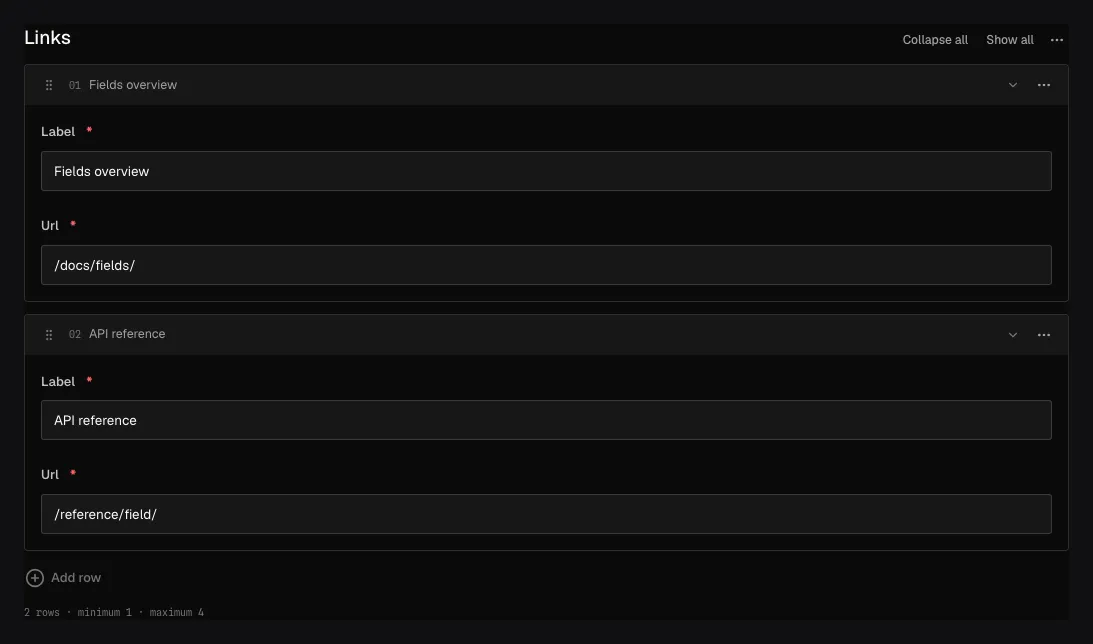
Rows can be reordered in the editor; the document preserves that order and one shared row shape.
Smallest working example
field.Array(
  "links",
  field.Fields(
    field.Text("label", field.Required()),
    field.Text("url", field.Required()),
  ),
  field.MinRows(1),
  field.MaxRows(12),
  field.RowLabel("label"),
){
"links": [{ "label": "Documentation", "url": "/docs/" }]
}At least one child definition is required. MinRows may be zero, MaxRows must be at least one,
and the minimum cannot exceed the maximum. RowLabel names a direct stored child used for an
accessible row heading.
Authoring and generated contracts
Authors can add, reorder, duplicate, and remove rows within configured bounds. ArrayRowLabels
changes singular/plural interface copy. A paired RowLabelComponent can render richer headings,
but keep RowLabel as its text fallback and remember that a component changes presentation only.
Generated types preserve the ordered row array. Validation issues include concrete indexes such as
links.2.url. Nested queries use canonical paths such as links.label; the array container supports
exists.
Localize a child for per-row localized values or the Array container when each locale owns an independent list and ordering. Container localization prevents descendant locale mixing.
Common mistakes
- Use Blocks for a list of different row types.
- Row order is data. Reordering can be meaningful even when every child value stays the same.
RowLabelmust point to a direct stored child, not a nested path or presentation field.- An array can grow request and document size quickly; set a realistic
MaxRows.
See field.Array, field.MinRows, and
field.RowLabel.