
Date field
Store a day, time, or RFC 3339 timestamp with an explicit picker contract.
Use field.Date for a calendar day, wall-clock time, or absolute timestamp. Date values remain
strings on the wire so their format and timezone meaning stay explicit.
In the admin
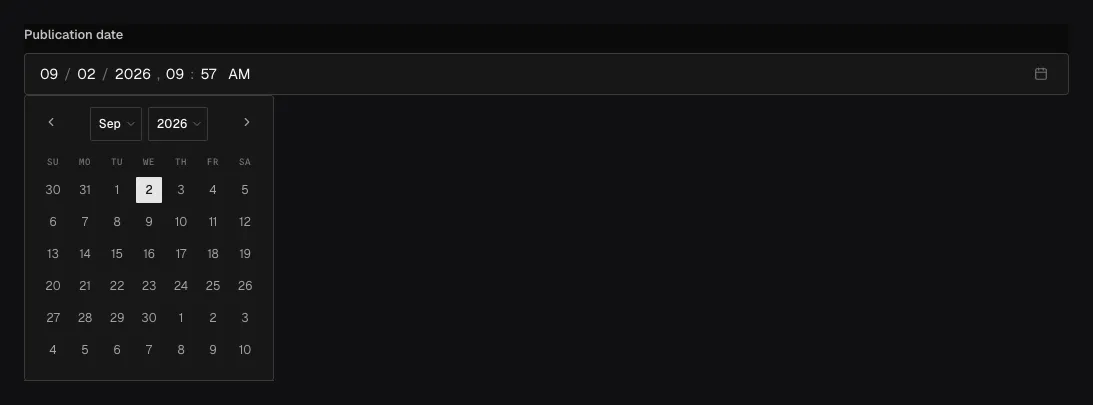
Picker appearance also selects the wire format; this day-and-time value is stored as an RFC 3339 timestamp.
Choose the value shape
field.Date(
  "startsAt",
  field.Required(),
  field.PickerAppearance(field.DatePickerDayAndTime),
)| Appearance | Accepted value | Use it for |
|---|---|---|
DatePickerDayOnly |
YYYY-MM-DD |
Birthdays, release days, and other calendar dates |
DatePickerDayAndTime |
RFC 3339 timestamp | An instant such as 2027-06-10T09:30:00Z |
DatePickerTimeOnly |
HH:mm or HH:mm:ss |
A local opening time without a date |
The selected appearance controls both server validation and the admin control. Omitting it uses the default; set it when consumers depend on one shape.
Options, querying, and localization
Date supports Required, string defaults, localization, uniqueness/indexing, and common admin
options. Filters and sorts compare normalized accepted date strings. Use RFC 3339 with an explicit
offset for day-and-time values; convert for display in the consumer rather than removing timezone
information before storage.
A localized date is appropriate only when the underlying content really differs by locale. A single event instant usually should not be localized merely because each audience formats it differently.
Common mistakes
- Do not send a JavaScript
Dateobject directly. Serialize a day/time string matching the chosen appearance. - A day-only value has no timezone. Do not convert it through midnight UTC and accidentally move it to another day.
- Time-only values need an application-owned timezone and recurrence model if they represent store hours or schedules.
See field.Date,
field.PickerAppearance, and querying.