
JSON field
Store JSON-compatible data when the application cannot model a stable nested shape.
Use field.JSON for JSON-compatible data whose shape is genuinely open or controlled by another
system. It accepts null, booleans, finite numbers, strings, arrays, and objects and generates
unknown in TypeScript so consumers must narrow the value before use.
In the admin
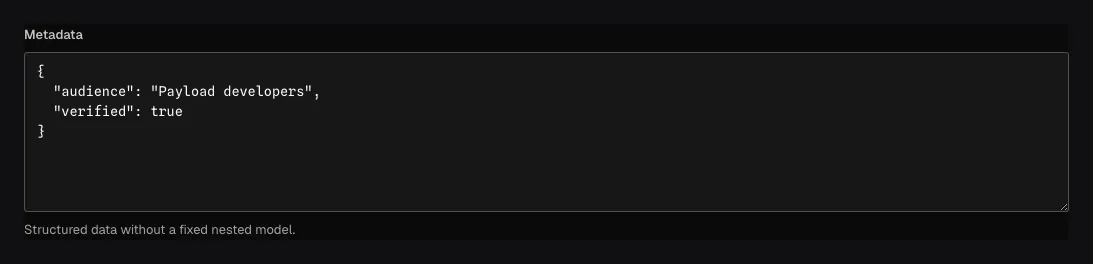
Authors edit open JSON; generated TypeScript exposes unknown, requiring consumers to narrow it.
Smallest working example
field.JSON(
  "providerMetadata",
  field.Description("Opaque metadata returned by the connected provider."),
)
The admin provides a JSON authoring control and the operation engine rejects malformed/non-JSON values from every transport.
When to model the shape instead
Prefer Group when the object has known properties, Array for repeated known rows, or Blocks for an authored union. Explicit fields produce better validation, migrations, generated types, filters, access paths, and admin controls.
JSON supports Required, Localized, conditions, and common presentation options. It
does not accept scalar Default, length, numeric, choice, or relationship options. Define a plugin
field when an open-looking value still needs a reusable validator and generated type.
Querying and localization
Select or omit the JSON property as one value. The query API does not support JSON path operators. Promote fields you must filter or sort into the content model.
Localized stores the whole JSON value independently per locale. Partial locale fallback applies
to the field value, not recursively to individual object keys.
Common mistakes
- Do not use JSON to avoid modelling a stable business object; consumers then lose generated contracts and path-aware validation.
- JSON does not accept functions,
undefined,Date,Map, circular values,NaN, or infinity. - Treat provider metadata as untrusted input even after JSON decoding.
See field.JSON and Generated contracts.