
Plugin field
Use a compiled plugin’s storage, validation, generated type, and paired admin control.
field.Plugin is the low-level constructor for a compiled field extension. Most applications use
a plugin-owned helper such as richtext.Field; that helper serializes valid config and prevents
callers from mistyping the plugin key.
In the admin
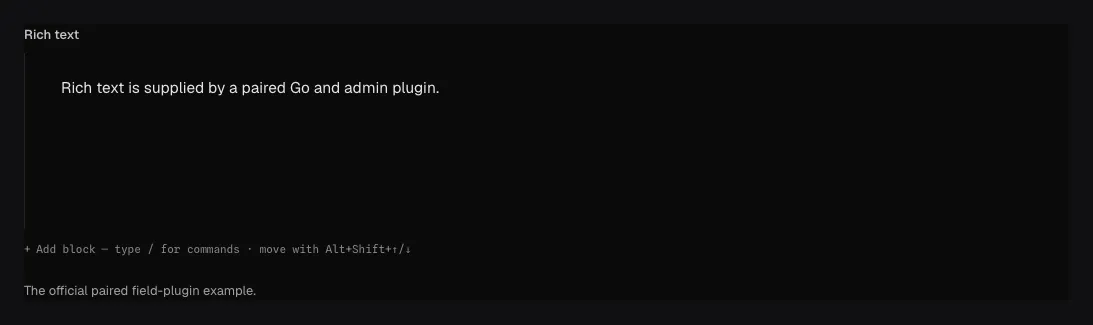
The Svelte control authors the value; its paired Go plugin defines server validation and the stored shape.
Prefer the plugin helper
import "github.com/riducms/ridu/plugins/richtext"

richtext.Field("content", field.Required())
The matching plugin must also be present in Config.Plugins, and its paired admin package must be
statically registered when the field needs a custom control. Run ridu add … to install both sides
and update their registration.
Low-level constructor
func Field(name string, config Config, options ...field.PluginOption) field.Definition {
  encoded, err := json.Marshal(config)
  if err != nil {
    panic(err)
  }
  return field.Plugin(name, Key, encoded, options...)
}
Plugin config must be deterministic public JSON. Never put secrets, callbacks, or request-specific
data in it. If config properties contain collection slugs, declare those exact property names with
CollectionReferenceKeys so schema-addressed migration checks can follow renames safely.
Define Go/TypeScript/OpenAPI mappings, runtime validation, admin pairing, and any supported query
type in the plugin descriptor. Without those mappings generated values fall back to
json.RawMessage/unknown; without a server validator a pretty control is not a finished field.
Only common safe options such as required, localized, labels, descriptions, layout, and conditions
are accepted by PluginOption.
Common mistakes
- Do not call
field.Plugindirectly when the package provides a typed helper. - Installing only the npm control or only the Go package creates an incomplete pair.
- Config is schema metadata, not the stored value.
- Test a custom field through resolution, generation, storage, Local API/REST, and the admin.
See field.Plugin, Plugin system, and the complete
custom field guide.